
I participated this week as a delegate at Cloud Field Day 23, and one of the most candid sessions so far came from HPE GreenLake and SAP. The focus? SAP Cloud ERP – formerly known as RISE – and their joint approach to helping legacy SAP ERP customers make the leap to their private cloud platform.
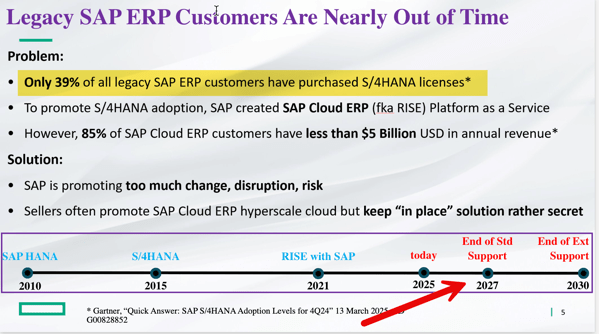
An early slide (highlights mine) hit with a stat that landed harder than I expected: as of the end of 2024, only 39% of legacy SAP ERP customers had actually purchased S/4HANA licenses. That’s not migration complete—that’s just licenses purchased. And that is for a product that goes End of Support in 2027. For a platform as mission-critical and sprawling as SAP ERP, it’s not hard to see why inertia reigns.
SAP and HPE’s proposed answer for hesitant customers? A hybrid approach called Customer Data Center (CDC) private cloud ERP. Think of it as SAAS, but running in your data center, on HPE hardware, maintained by both SAP and HPE. Customers get cloud operations and SAP support continuity, while keeping their workloads and their data close to home. It’s designed to help customers avoid falling off the end-of-support cliff while buying time to transition on their terms.
The session also included a customer perspective from Energy Transfer, a US firm with 130,000 miles of pipeline in 44 states and one of the early adopters of this CDC model. They were refreshingly transparent. Yes, there were “sticks and carrots” involved in the decision, but the biggest carrot for them was the promise of access to Joule – SAP’s agentic AI platform. Joule is only available in SAP’s public SaaS offering or this private CDC model, making it a compelling draw. Energy Transfer’s non-negotiable condition? The transition had to be cost-neutral.
SAP also described how they structure their engagement model to support projects of this magnitude. Given how many ERP projects fail or flounder due to continuity issues, I asked a question during the session about team depth. Specifically, how do they manage institutional knowledge when key personnel inevitably move on? SAP’s response was pragmatic: their named project teams are regional, and roles are built with intentional overlap. Each team member is flanked by someone one level above and one level below who is looped in, to smooth transitions if (when) someone leaves. As someone who has had to step into the gap when colleagues take other opportunities and now manages a team, that struck me as both smart and necessary.
HPE and SAP didn’t shy away from the business reality underpinning all of this. The perpetual license model is dying, and subscription-based models are now the norm. While some customers still pine for the days of CapEx and perpetuals, HPE and SAP are incentivizing the move to recurring revenue models in a way that’s clearly designed to align better with how modern IT is financed and measured.
Bottom line? Public Cloud ERP isn’t one-size-fits-all, and by SAP’s admission isn’t ready for many of their complex and customized customer environments. This hybrid CDC approach acknowledges that reality. Not every enterprise is ready to go all-in on SaaS, and some may never be. SAP and HPE GreenLake seem to understand that, and the CDC model looks like a pragmatic (and carrot-laced) middle path.
 Mike Stanley