
I’ve long believed that backup isn’t just a checkbox—it’s a strategy. So when Clumio took the virtual stage at Cloud Field Day 23, I was curious to see how a backup-as-a-service vendor could stand out in a space where “cloud-native” is often more branding than architecture. What I saw was a team leaning hard into the AWS ecosystem—not just running on AWS, but with it, using native services like EventBridge and Lambda to build a scalable, serverless platform designed for automation.
Clumio, acquired by Commvault in 2024, now serves as the cloud-native backbone of Commvault’s broader data protection strategy. It’s their answer for teams that live inside AWS and don’t want to manage backup infrastructure—but still need performance, isolation, and scale.
Clumio isn’t trying to reinvent backup. It’s not asking you to forklift your data to some third-party silo or wrap agents around every workload you touch. Instead, it’s offering a clean and efficient way to protect AWS-native data, from S3 and EBS to DynamoDB and RDS, without managing infrastructure, hardware, or even backup windows.
What makes Clumio interesting isn’t just that it backs up your cloud—it’s how it separates your backups from your primary environment without leaving the cloud. That “logical air gap” model, paired with strong performance claims and aggressive pricing, adds up to a platform that doesn’t try to be everything—but does a few critical things very well.
Air Gaps, Automation, and Architecture That Makes Sense
Clumio’s “logical air gap” is a key part of its security and resilience story. Your backups live in a completely separate AWS account, managed by Clumio, dedicated to your organization, and inaccessible without explicit authorization. It’s not a physical gap—this isn’t the old-school offline tape model—but it is real isolation. A compromised IAM role in your production account doesn’t give attackers access to your backup data.
What’s especially compelling is how Clumio achieves this without requiring agents, proxies, or any backup infrastructure in your account. After an initial CloudFormation or Terraform deployment, everything else runs on Clumio’s side—fully serverless, driven by EventBridge, and orchestrated with Lambda. It’s a clean, automated pipeline that’s responsive to changes and designed to scale without babysitting.
This isn’t just about elegance. It’s about reducing operational overhead for teams already stretched thin. And Clumio backs that up with a support model that resolves 95–98% of tickets proactively, before most users even know there’s a problem. The platform is engineered for invisibility in the best way—hands-off, API-driven, and infrastructure-free.

Granularity, Performance, and Real-World Outcomes
Clumio’s flexibility comes into sharper focus when you look at how it handles S3 and DynamoDB. For S3, protection groups allow you to define exactly what gets backed up—by tag, prefix, region, or any combination thereof. Instead of duplicating entire multi-purpose buckets, you can target the slice that matters, which helps with both cost and compliance.
DynamoDB protection is table-level, and leverages streams for incremental capture. That’s a big win over full-table snapshots—especially for large, high-throughput environments—because it means lower cost, shorter RPOs, and faster restores.
And the numbers? They’re hard to ignore:
- 100M object restore in 9 hours, compared to 3 days with AWS-native tools.
- 50+ billion object support per bucket, well above AWS’s 7.5B limit.
- Sub-hour RPOs thanks to continuous change tracking.
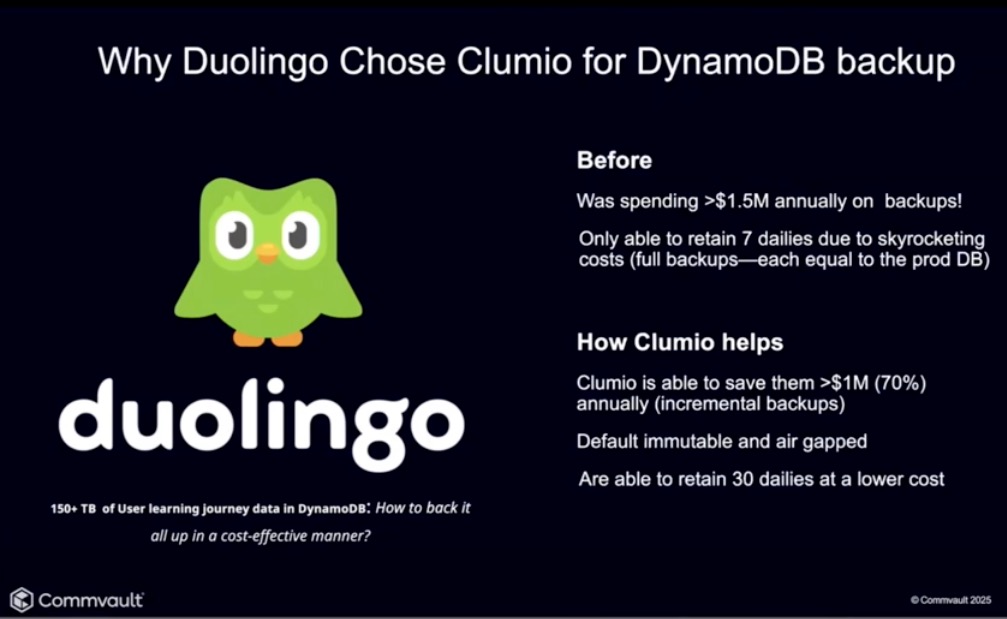
Case studies bring those claims into focus. Atlassian dropped their RTO from 248 days to under 2, and cut costs by 70%. Duolingo saved over $1M annually on DynamoDB backup while increasing retention from 7 to 30 dailies. These aren’t marginal gains. They’re systemic improvements—both in speed and economics.
Pricing and the Big Picture
Clumio’s pricing is refreshingly straightforward: $0.025 per GB per month (front-end backup size), plus $1.50 per million objects managed. Restore and cross-region transfer costs apply only during recovery. Air-gapped storage comes standard—no extra fees, no extra knobs to turn.
The takeaway? Clumio isn’t trying to do everything. It’s built for AWS customers who want native integration, automation without the overhead, and real control over their backup data. You won’t find support for Azure or GCP (yet), and it doesn’t pretend to be a legacy replacement for every use case. What it does do is give you a scalable, secure, efficient way to back up and restore critical AWS services without dragging along the complexity of traditional platforms.
That said, no matter how invisible or “set and forget” the platform seems, you still need to care about your backup strategy. Automation is only as good as your observability and validation practices. But if you’re all-in on AWS and still leaning on snapshots and lifecycle policies, Clumio is worth a serious look.
To watch the video of the #CFD23 presentation by Commvault on Clumio, go to the Tech Field Day’s YouTube channel.
 Mike Stanley